An IoT sensor is useful to a maintenance team when its measurement changes a defensible maintenance decision. A connected device that produces more graphs without a clear response can add cost and distraction. Start with the equipment, the failure you need to understand, and the person who can act on the evidence.
This guide covers the practical path from selecting a signal to closing the resulting maintenance work. It is a procurement and workflow guide, not an equipment-specific installation procedure or a claim that a general CMMS contains predictive analytics. Mounting, electrical work, process changes and protection systems require the appropriate qualified review.
Start with a failure mode, not a sensor catalogue
Describe the function the asset must perform and the loss of function that matters. “Monitor the pump” is too broad to evaluate. A more useful requirement identifies a particular concern, the operating conditions in which it appears, the evidence needed to distinguish it from ordinary variation, and the decision the team expects to make.
Ask the responsible equipment specialist whether the proposed measurement is relevant to that failure mechanism. Temperature, vibration, pressure and electrical measurements answer different questions. None provides a universal diagnosis. A useful measurement may still need operating speed, load, ambient conditions, lubricant history or another signal before a person can interpret it.
Write down the current method as well. If an established route inspection already identifies the issue in time for a planned intervention, connectivity must justify its extra installation, support and analysis burden. The alternative might be improving the route, repairing an unreliable measurement point, or making existing findings easier to act on.

AI-generated editorial illustration; not a customer photograph or product screenshot.
Match the measurement to the decision
Vibration measurements can contribute evidence about rotating equipment condition. Their usefulness depends on the machine, sensor placement, measurement method and analysis. A single overall value should not be presented as proof of a specific bearing defect. Ask the supplier what information is retained and what specialist interpretation is required.
Temperature measurements can reveal a change that warrants investigation, but a temperature without context is ambiguous. Process temperature, loading, cooling and ambient conditions may explain a change. Use the applicable equipment guidance and approved site criteria; there is no universal temperature in this article at which every motor or bearing is unsafe.
Pressure and flow measurements can help investigate process performance when the measurement range, connection and operating context are appropriate. Electrical measurements may help specialists evaluate motor or supply behaviour. Oil analysis is another condition-monitoring method, although a laboratory sample is not automatically a continuously connected IoT sensor.
| Measurement question | Context to retain | Decision to test in the pilot |
|---|---|---|
| Has the observed condition changed? | Baseline, load, operating state and timestamp | Does the change justify qualified review? |
| Is the observation repeatable? | Measurement point, method and sensor identity | Should the team repeat or validate the reading? |
| Does the finding relate to a known failure mode? | Equipment history and technical interpretation | Is an inspection or planned intervention appropriate? |
| Did the intervention address the concern? | Before-and-after observations under comparable conditions | Can the reviewer close the finding or is follow-up required? |
Define the measurement specification before buying
Give the supplier a written application description. Include the equipment identity, environment, intended measurement, available mounting locations and operational constraints. Ask for the proposed device's relevant specifications, installation requirements and limitations. A product name and an attractive dashboard are insufficient for an engineering selection.
The responsible specialist should review measurement range, accuracy, repeatability, resolution and sampling requirements for the actual application. Those terms are related but not interchangeable. A display with many decimal places does not establish that the installed measurement is accurate enough to support the intended decision.
Check the environmental and installation requirements with the appropriate site owner. Moisture, washdown, temperature, vibration exposure, hazardous areas and cable routing can affect suitability. Confirm how installation and servicing will be performed under the site's approved procedures. Do not create an informal exception to guarding, isolation or access controls merely to collect data.
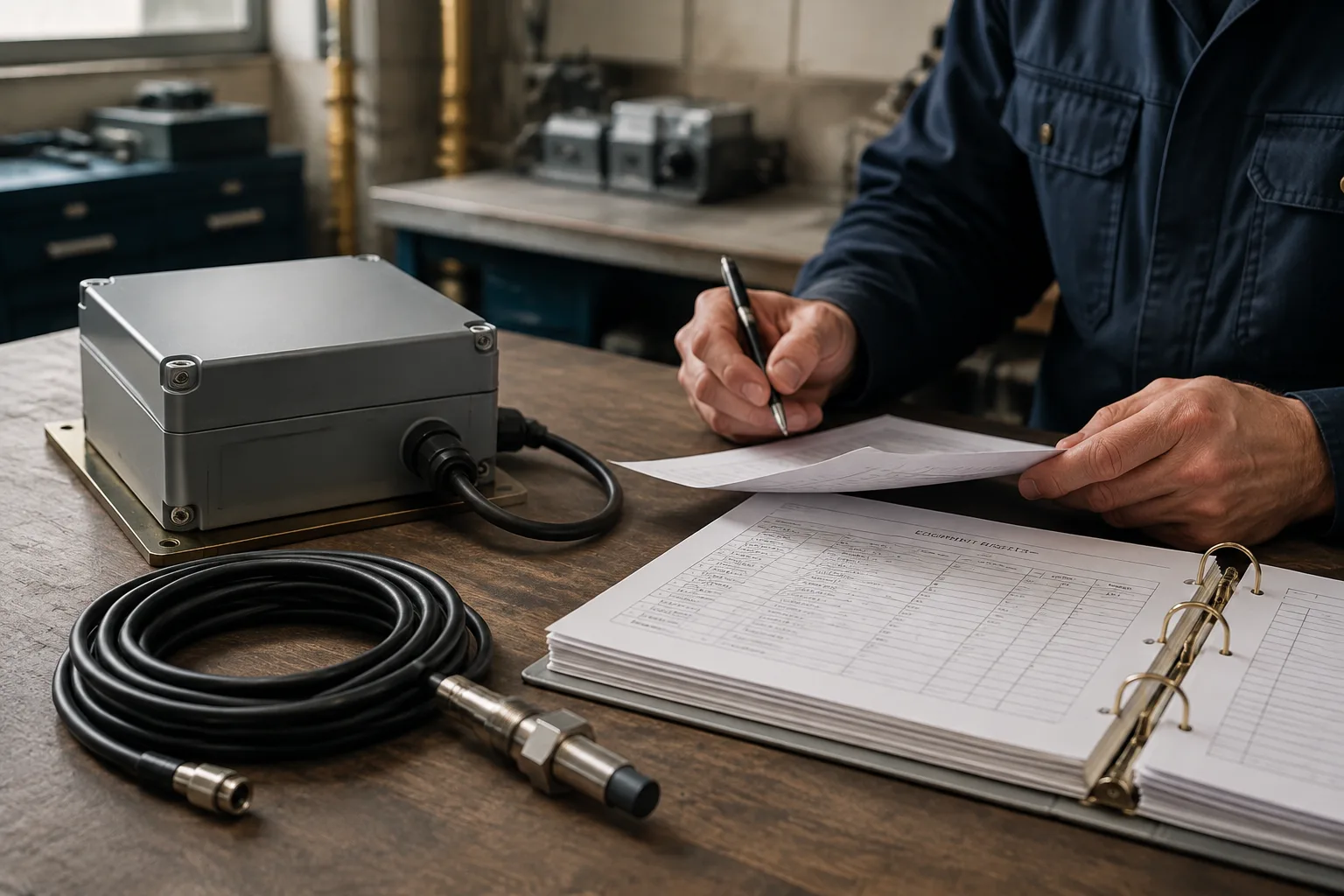
AI-generated editorial illustration; not a customer photograph or product screenshot.
Keep sensor identity separate from asset identity
Maintain a mapping between the physical asset and the device or measurement point. The record should identify the site, asset code, sensor identifier, measurement type, units, mounting position and effective installation date. Avoid relying solely on a display name such as “Pump 1,” which may be reused at several locations.
A sensor can be replaced while the asset remains in service. An asset can also be replaced while a sensor or dashboard label remains. Record those changes explicitly so a trend does not silently combine observations from different physical equipment. Historical interpretation depends on knowing which configuration produced each observation.
Make the mapping reviewable by the people who know the equipment. During commissioning, trace a sample from the physical identification through the gateway or source platform to the maintenance record. Correct ambiguity before enabling automated downstream actions. A technically valid reading assigned to the wrong asset can be more misleading than a visibly missing reading.
Treat units and timestamps as part of the measurement
Retain the unit with every measurement or in an unambiguous channel definition. Do not mix temperature scales, distance units or runtime units in the same history without an explicit conversion. Record any transformation so the source value and the value used for a decision can be reconciled.
Distinguish when a reading was measured from when it was received. A delayed upload may be valid historical evidence without representing the current condition. Use a consistent time convention and preserve enough context to interpret records across sites. A dashboard that shows the latest received value should also make its age understandable.
Define the handling of missing, stale, invalid and out-of-range data. Missing data is not a normal reading and should not automatically clear an unresolved finding. Equally, a communication fault is not proof of equipment failure. Give data-quality exceptions a separate owner and response from condition exceptions.
Design the connection around operational ownership
Identify who owns the sensor, gateway, network connection, source platform and maintenance integration. Write down the support route for each component. Otherwise, an unanswered alert can become a chain of teams each assuming another team maintains the connection.
Ask IT and operational technology owners to review connectivity before installation. Establish the required access, account ownership, update process and support arrangements. Use the organization's approved security requirements and the supplier's documented deployment guidance. A maintenance pilot should not introduce unmanaged remote access or shared credentials that nobody can revoke responsibly.
Keep observation and control distinct. A general monitoring integration is not a safety instrumented function, protective relay or authorized machine-control system. Do not route a maintenance notification into an improvised shutdown command. If a project includes control or protection, treat that as a separately engineered and approved scope.

AI-generated editorial illustration; not a customer photograph or product screenshot.
Establish a baseline under representative operation
Collect enough representative observations for the responsible specialist to understand normal variation for the chosen application. Record relevant operating states and known changes. A baseline collected while equipment is idle may not support conclusions about the same equipment at production load.
Document how the baseline was accepted, including unresolved limitations. If there is no reliable history, say so. A pilot can begin with observation and manual review while the team builds confidence. It does not need an automated diagnosis or a confident remaining-life estimate to be useful.
Revisit the baseline after material changes such as replacement, relocation, process modification or a different measurement position. Preserve the old version for historical interpretation. An apparent improvement or deterioration may reflect a changed measurement configuration rather than a changed asset condition.
Write an alert policy a person can operate
Define what creates an alert, who reviews it, what evidence accompanies it, and what happens if the reviewer is unavailable. Include a route for acknowledging an alert without claiming the underlying condition has been resolved. Acknowledgement, investigation and maintenance completion are different events.
Ask the qualified reviewer to establish the relevant criteria. Avoid copying a threshold from another machine merely because its name or appearance is similar. Where persistence, operating-state filters or escalation rules are used, document their purpose and test the resulting behaviour with representative examples.
Plan for repeated observations of the same unresolved concern. Decide whether they update an existing finding or create a distinct issue. Uncontrolled duplication can obscure the backlog, while aggressive suppression can hide a materially different condition. Keep the rule understandable and give reviewers a way to correct an incorrect association.
Turn a reviewed finding into an executable work order
A useful handoff contains the asset, observed condition, observation time, source reference, relevant context and requested next action. It should distinguish the observation from a suspected diagnosis. “Condition changed under comparable load; inspect using the approved procedure” is more defensible than declaring a component failed without supporting analysis.
The planner still needs to determine scope, skills, access, parts and an appropriate work window. A sensor cannot establish that all prerequisites are available. If the finding needs further diagnosis, create that diagnostic task rather than prematurely scheduling a specific replacement.
Link the resulting work record back to the finding. At completion, capture what was actually found, what action was taken and what verification remains. This gives the reliability team feedback about the usefulness of the original alert and gives the next technician a record they can understand.

AI-generated editorial illustration; not a customer photograph or product screenshot.
Test the integration with normal and abnormal cases
Begin with a small, authorized data sample. Verify asset mapping, units, timestamps, permissions and the destination record. Then test duplicates, delayed messages, missing fields, an unknown asset and an unavailable destination. Keep a record of expected and observed behaviour.
Make retries safe and visible. Before repeating an import after a timeout, establish whether the first attempt created a record. The integration should have a documented way to identify repeated source events or a controlled reconciliation process. A successful HTTP response alone does not establish that the right work reached the right team.
Test credential expiry or revocation through an approved nonproduction or bounded test arrangement. Confirm who notices the failure and how normal service is restored. Include the loss of the original integration administrator in the handover plan so the connection does not depend on one person's account or memory.
Evaluate a pilot using decision quality
Do not judge a pilot only by the number of readings or alerts. Review whether the measurements were interpretable, whether the reviewer could distinguish data problems from equipment concerns, and whether resulting work contained useful information. Record the analyst and planner effort required to reach those decisions.
Separate confirmed findings, unresolved findings, data-quality incidents and alerts that did not warrant maintenance. An alert that prompts a reasonable inspection but finds no defect is not automatically a failure; its value depends on the purpose and evidence. Equally, a long list of notifications does not demonstrate prevented breakdowns.
Review missed concerns as well as detected ones, where evidence is available. A system cannot prove universal detection by showing only successful examples. Use the pilot to decide whether to expand, revise the measurement or response, continue observing, or stop the application because it does not support a useful decision.

AI-generated editorial illustration; not a customer photograph or product screenshot.
Build a total-cost view of the sensor workflow
Include installation, approved access arrangements, connectivity, platform subscriptions, integration work and ongoing interpretation. Also account for sensor servicing, replacement, calibration or verification where applicable, and the time required to investigate data-quality problems. These costs can matter even when the device itself is inexpensive.
Ask what happens when the subscription ends or the device is replaced. Confirm access to historical readings, configuration records and exports in the commercial and technical documentation. Review who can retrieve the data and whether another tool can interpret the exported fields.
Estimate potential benefit using an explicit operational mechanism. If the proposed benefit is earlier planning, identify what decisions could change and what evidence would demonstrate the change. Keep hypothetical avoided failures separate from observed savings. Do not count the same event as downtime savings, production savings and labour savings without checking for overlap.
Maintain the monitoring system after launch
Add the monitoring equipment to an appropriate ownership register. Someone must notice a disconnected device, a changed asset mapping or an expired account. Define how configuration changes are requested, reviewed, tested and documented. Silent changes make historical comparisons difficult to trust.
Review whether alerts still serve the intended failure mode after operating conditions change. A new product, revised duty or equipment replacement may invalidate an earlier assumption. Keep maintenance, operations and the relevant technical specialist involved rather than delegating every decision to the dashboard administrator.
Retire channels deliberately. Record why a measurement was discontinued, preserve relevant history according to the organization's requirements, and remove obsolete downstream rules. Leaving abandoned channels visible as though they are current can confuse both planners and future analysts.
Where PreventiveHQ fits in the workflow
PreventiveHQ can organize the maintenance work that follows a reviewed finding through asset records, work orders, inspections and schedules. That operating record is distinct from specialist signal acquisition, diagnostic interpretation or a predictive model.
The Samsara integration has a specific vehicle-meter scope. It should not be read as support for every industrial sensor, arbitrary waveform ingestion or autonomous failure prediction. Review the relevant integration page and test the exact supported fields before including an integration in a purchase decision.
To evaluate the workflow, choose one asset and a manually reviewed finding. Create the required work, complete it with the appropriate evidence, and ask another authorized user to retrieve the history. If that handoff is useful, document what further integration would need to do. Start with the public demo and compare the actual workflow with your requirements.

AI-generated editorial illustration; not a customer photograph or product screenshot.
A commissioning record to keep with the project
Create a short record that joins the technical and operational decisions. Include the application purpose, responsible specialist, asset and measurement mapping, accepted configuration, data-quality rules, alert owner, work-order handoff and pilot acceptance criteria. Attach the relevant supplier documentation and approved site references rather than copying uncontrolled fragments into several places.
Record unresolved questions explicitly. For example, the pilot may establish that readings reach the correct asset while leaving diagnostic usefulness unproven. That is a narrower result than a successful predictive-maintenance deployment. Keeping the distinction visible helps the next decision-maker understand what has actually been demonstrated.
Before expansion, have the receiving team operate the workflow without the project lead translating every alert. Check that they can identify stale data, locate the source observation, assign an appropriate next action and retrieve the completed evidence. This practical handover is the point where a connected sensor becomes part of an owned maintenance process.
Questions for the supplier handover
Ask the supplier to show how a replacement sensor is associated with the existing asset, how a disconnected channel is displayed, and how an administrator retrieves an older observation with its original timestamp. Have the receiving team perform those tasks rather than only watching a presentation. Record any assistance needed and the documentation used to recover.
Confirm the boundary of each support agreement. A hardware supplier may establish that a device transmits correctly without accepting responsibility for the diagnostic model or the maintenance response. An integration provider may deliver records without owning their engineering interpretation. Assign those responsibilities explicitly in the project record and confirm an escalation route for an issue that crosses the boundary.
The joint Secure by Demand guidance for OT owners and operators provides a primary reference for including security in procurement. Use it with your organization's requirements when reviewing a connected monitoring proposal.