Building maintenance management coordinates the work needed to keep building systems and occupied spaces usable. The practical challenge is connecting occupant reports, equipment responsibilities, access and contractor evidence. Start with those handoffs before choosing a service delivery model.
Commercial vs Residential Building Maintenance
While fundamental maintenance principles apply universally, commercial and residential buildings require different approaches, expertise, and regulatory compliance.
Key Differences
Scale and Complexity: Commercial buildings typically feature larger, more sophisticated systems including central HVAC plants, fire suppression systems, elevators, building automation systems, and complex electrical distribution. Residential buildings often use simpler, decentralized systems like individual HVAC units, basic electrical panels, and minimal automation.
Maintenance Staff: Commercial buildings often employ dedicated maintenance teams, specialized contractors, and facility management professionals with technical certifications. Residential properties may rely on property managers with general maintenance knowledge, on-call handyman services, or contracted specialists for specific systems.
Tenant Considerations: Commercial tenants expect minimal operational disruption, professional communication, coordinated maintenance scheduling, and immediate emergency response. Residential tenants prioritize privacy, after-hours quiet, reasonable notice for entry, and responsive repairs affecting livability.
Operating Hours
Commercial building maintenance must accommodate business operations, requiring after-hours scheduling for disruptive work, 24/7 emergency response for mission-critical facilities, and coordinated shutdowns for major maintenance. Residential maintenance offers more flexibility with daytime access to vacant units, though occupied units still require advance notice and consideration for tenant schedules.
Documentation Requirements
Commercial buildings maintain extensive compliance documentation, detailed equipment service records, warranty tracking, and tenant communication logs for liability protection. Residential properties require basic maintenance records, tenant request documentation, and safety inspection records, though with less formality than commercial properties.
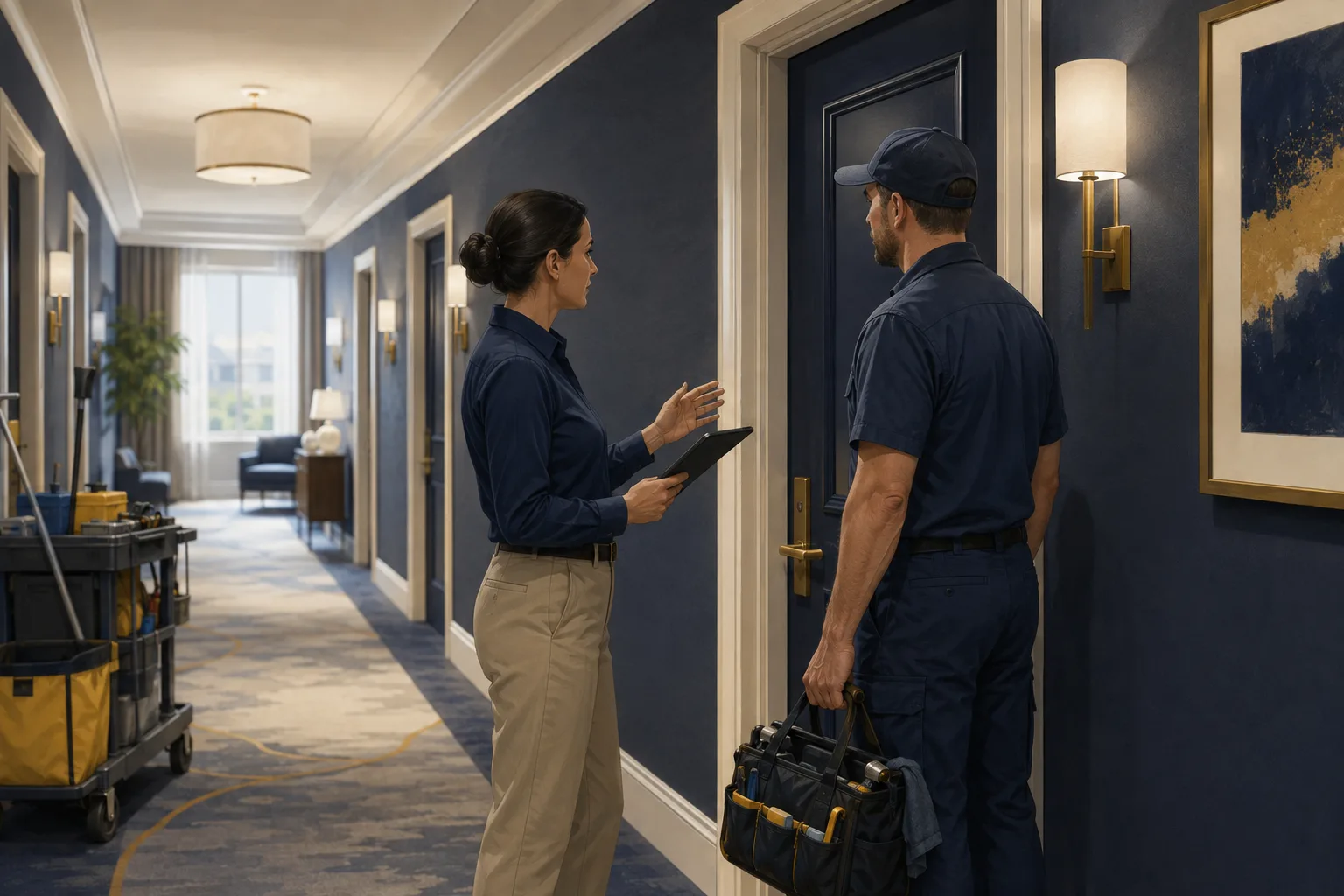
AI-generated editorial illustration; not a customer photograph or product screenshot.
Property Maintenance Services
Comprehensive property maintenance requires coordinating multiple specialized services. Understanding what each service entails helps property managers build effective maintenance programs and select qualified contractors.
HVAC Maintenance
Heating, ventilation, and air conditioning systems represent critical property components requiring regular professional attention. HVAC maintenance includes filter changes, system inspections, cleaning coils and components, checking refrigerant levels, testing controls, and ensuring efficient operation.
Seasonal maintenance is essential—servicing heating systems before winter and cooling systems before summer prevents breakdowns during peak demand. Commercial properties often require more frequent HVAC maintenance due to larger, more complex systems and continuous operation. Annual maintenance contracts with qualified HVAC contractors ensure consistent service and typically include priority emergency response.
Plumbing Services
Plumbing maintenance prevents water damage, ensures reliable water supply, and maintains sanitation systems. Services include drain cleaning, pipe inspections, water heater maintenance, fixture repairs, leak detection, and sewer line maintenance.
Preventive plumbing maintenance pays significant dividends. Regular drain cleaning prevents backups. Annual water heater flushing extends equipment life. Leak detection identifies problems before they cause extensive damage. For older properties, pipe inspections using camera technology identify developing issues like root intrusion or corrosion before pipes fail.
Electrical Systems
Electrical maintenance ensures safety, prevents fires, and maintains reliable power. Services include panel inspections, circuit testing, outlet and switch repairs, lighting maintenance, surge protection, and code compliance verification.
Electrical issues pose serious safety risks. Licensed electricians should handle all but the most basic maintenance tasks. Regular inspections identify hazards like overloaded circuits, outdated wiring, faulty breakers, and improper installations that could cause fires or injuries.
Roofing and Exterior
Roof maintenance protects entire buildings from water damage. Services include inspections, leak repairs, gutter cleaning, flashing repairs, seal coating, and addressing wear from weather and age.
Roofs require inspection at least twice annually—once before winter and again in spring. Prompt attention to minor issues prevents major damage. Water intrusion damages interiors, promotes mold growth, and compromises structural integrity. Regular maintenance extends roof life significantly, delaying costly replacement.
Landscaping and Grounds
Grounds maintenance creates attractive, functional outdoor spaces. Services include mowing, trimming, pruning, fertilization, irrigation system maintenance, seasonal plantings, tree care, and hardscape maintenance.
Regular landscaping maintenance prevents small issues from becoming expensive problems. Overgrown vegetation damages buildings and creates pest habitats. Unmaintained irrigation systems waste water and money. Dead trees pose safety hazards. Professional landscape services ensure grounds remain attractive and safe while protecting long-term property condition.
Cleaning Services
Regular cleaning maintains property appearance and hygiene. Services vary by property type but typically include common area cleaning, window washing, carpet cleaning, pressure washing, trash removal, and specialized cleaning for specific spaces.
Commercial properties often require daily cleaning of high-traffic areas. Residential properties need regular common area attention and thorough cleaning between tenant turnover. Professional cleaning services ensure consistent results and free property management staff for other responsibilities.
Pest Control
Pest management protects property and tenant health. Services include regular inspections, preventive treatments, targeted elimination of infestations, exclusion work sealing entry points, and education about prevention practices.
Proactive pest control is far more effective and affordable than addressing infestations after they occur. Monthly or quarterly service contracts with licensed pest control professionals maintain pest-free properties while satisfying regulatory requirements in many jurisdictions.
Snow Removal (Seasonal)
Winter maintenance ensures safety and accessibility in cold climates. Services include snow plowing, ice removal, de-icing treatments, sidewalk clearing, and monitoring weather conditions for timely response.
Snow removal contracts should be negotiated before winter, establishing trigger depths for plowing, response times, and coverage areas. Liability for slip-and-fall accidents makes prompt, thorough snow removal essential. Many property managers contract with services offering 24/7 monitoring and automatic response when snowfall reaches specified depths.
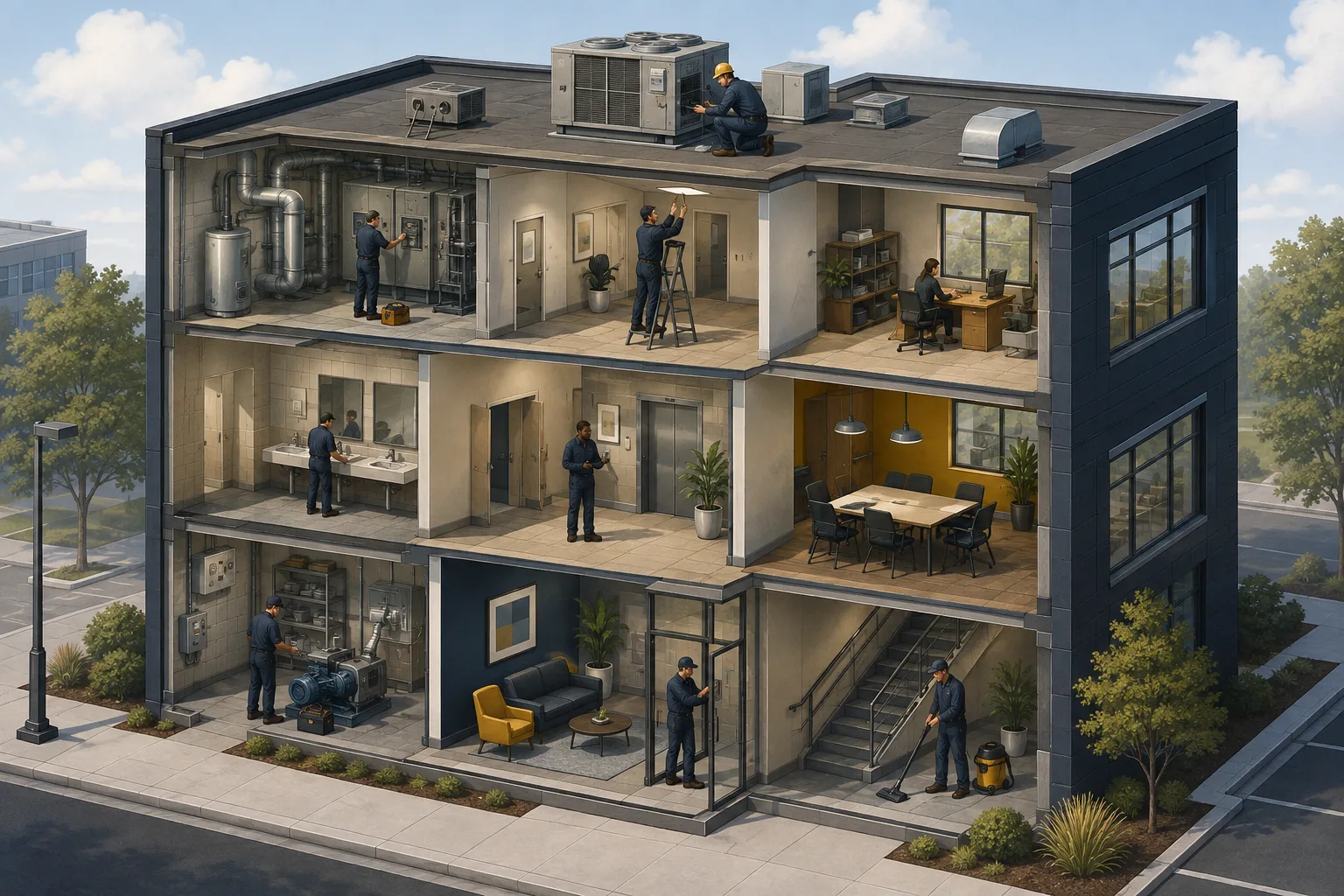
AI-generated editorial illustration; not a customer photograph or product screenshot.
Facility Maintenance Services: Comprehensive Overview
Effective facility maintenance programs encompass a wide range of specialized services, each requiring specific expertise, equipment, and maintenance approaches. Understanding the full scope of facility maintenance services enables facility managers to develop comprehensive maintenance plans that address all building systems and infrastructure.
Mechanical Systems Maintenance
Mechanical systems form the heart of modern facility operations, providing heating, cooling, ventilation, and various process functions. These complex systems require regular maintenance to ensure efficiency, reliability, and longevity.
HVAC maintenance represents the most extensive mechanical service category. Regular tasks include monthly or quarterly filter changes, seasonal system startups and shutdowns, annual refrigerant charge verification and leak testing, belt inspection and tension adjustment, bearing lubrication on motors and fans, coil cleaning to maintain heat transfer efficiency, condensate drain cleaning to prevent overflow, control calibration to ensure accurate temperature and humidity control, economizer testing and adjustment, and ductwork inspection and sealing.
Boiler and heating system maintenance ensures safe, efficient operation during heating season. Critical activities include annual inspections before heating season, combustion analysis and efficiency testing, burner cleaning and adjustment, safety control testing including high limit and low water cutoff devices, pressure relief valve testing, water treatment to prevent scaling and corrosion, insulation inspection and repair, and flue and venting system inspection.
Chiller maintenance preserves cooling capacity and efficiency. Services include refrigerant level monitoring and leak detection, oil analysis on compressors, condenser and evaporator tube cleaning, control system calibration, starter and electrical connection inspection, vibration analysis on rotating components, water treatment for condenser water systems, and seasonal startup and shutdown procedures.
Pump and motor maintenance applies across various systems. Regular services include coupling alignment verification, vibration analysis, bearing inspection and lubrication, seal inspection and replacement, motor winding insulation testing, electrical connection tightening, and performance testing including flow, pressure, and power consumption.
Mechanical system maintenance should follow manufacturer recommendations but may require adjustment based on operating conditions, equipment age, and criticality. Systems operating in harsh environments or critical applications need more frequent attention than those in controlled conditions or non-critical roles.
Electrical Systems Maintenance
Electrical system maintenance ensures safe, reliable power distribution while preventing potentially catastrophic failures. Many electrical maintenance tasks require licensed electricians due to shock and arc flash hazards.
Power distribution system maintenance includes annual thermographic inspections to detect hot connections before failure, torque verification on bolted connections, ground resistance testing, breaker and fuse inspection and replacement, transformer oil testing, battery testing and replacement for UPS and emergency systems, transfer switch testing for emergency generators, and electrical panel cleaning and debris removal.
Lighting system maintenance improves energy efficiency and occupant comfort. Services include lamp and ballast replacement on failure or relamping schedules, fixture cleaning to maintain light output, occupancy and daylight sensor calibration, photocell testing and adjustment, emergency lighting monthly function testing and annual battery discharge testing, and LED driver replacement as needed.
Generator maintenance ensures emergency power availability when needed most. Regular services include weekly or monthly exercise runs under load, oil and filter changes per manufacturer schedules, coolant system inspection and service, battery testing and maintenance, fuel quality testing and polishing, transfer switch testing, and annual load bank testing to verify full capacity.
Electrical safety programs should include arc flash hazard analysis and labeling, lockout/tagout procedures and training, personal protective equipment (PPE) requirements, and electrical safety audits.
Many facilities perform visual inspections and basic maintenance in-house while outsourcing thermographic surveys, transformer testing, and emergency generator load bank testing to specialized contractors with necessary equipment and expertise.
Plumbing and Water Systems
Plumbing maintenance prevents leaks, ensures water quality, and maintains adequate pressure and flow throughout the facility.
Domestic water system maintenance includes backflow preventer annual testing and certification, water heater inspection and flushing, pressure reducing valve testing and adjustment, temperature and pressure relief valve testing, fixture repair and replacement, pipe insulation inspection and repair, and leak detection and repair programs.
Drainage system maintenance prevents backups and water damage through periodic drain cleaning to remove buildup, grease trap cleaning in food service facilities, roof drain inspection and cleaning, sump pump testing and maintenance, ejector pump inspection and service, and camera inspection of drain lines when issues arise.
Water treatment systems require filter changes, softener regeneration and salt replenishment, reverse osmosis membrane replacement, UV disinfection lamp replacement, chemical feed system calibration, and water quality testing.
Plumbing emergencies like major leaks require immediate response. Facilities should maintain emergency contacts, know main shutoff locations, and keep basic repair supplies on hand for common issues.
Fire and Life Safety Systems
Fire extinguisher maintenance requires monthly visual inspections, annual professional maintenance and inspection, hydrostatic testing at prescribed intervals, and immediate replacement or recharge after any use.
Many jurisdictions require licensed fire protection contractors to perform testing and certify compliance. Facilities must maintain meticulous documentation as evidence of regulatory compliance and for insurance purposes.
Building Automation Systems
Modern building automation systems (BAS) integrate HVAC, lighting, security, and other systems into unified digital platforms. These sophisticated systems require ongoing maintenance to realize their full value.
BAS maintenance includes software updates and security patches, sensor calibration and accuracy verification, control sequence optimization based on occupancy and weather patterns, alarm review and threshold adjustment, database cleanup and archiving, user training on system features, graphics updates reflecting building changes, and integration maintenance with connected systems.
Cybersecurity has become critical for BAS connected to enterprise networks or the internet. Facilities should implement network segmentation, password management and access controls, vulnerability scanning and remediation, and incident response procedures.
Regular performance reviews identify optimization opportunities like scheduling adjustments, setpoint optimization, dead band tuning, and equipment staging improvements that reduce energy consumption while maintaining comfort.
Structural and Architectural Maintenance
Building envelope and structural maintenance preserves asset value and prevents water intrusion, the leading cause of building deterioration.
Roof maintenance prevents leaks and extends roof life through twice-annual inspections, drain and gutter cleaning, membrane repair, flashing inspection and sealing, ballast stone reset, penetration sealing, and roof asset condition documentation.
Exterior maintenance includes caulking and sealant renewal, masonry tuckpointing and repair, window and glazing system maintenance, door adjustment and weather stripping replacement, and exterior painting and coating application.
Interior maintenance addresses flooring repair and replacement, ceiling tile replacement, wall repair and painting, door and hardware adjustment, and millwork refinishing.
Building envelope failures often manifest as interior water damage, requiring rapid response to identify the source and prevent further deterioration.
Grounds and Exterior Maintenance
Exterior maintenance preserves curb appeal, ensures safety, and protects parking and hardscape infrastructure.
Landscape maintenance includes mowing and edging, pruning and trimming, mulching and edging bed areas, irrigation system operation and adjustment, seasonal plantings, fertilization and pest control, and leaf and debris removal.
Hardscape maintenance addresses parking lot crack sealing and sealcoating, pavement striping, sidewalk repair, fence and gate maintenance, exterior lighting, and stormwater system cleaning.
Winter maintenance in applicable climates includes snow plowing and removal, ice melt application, entrance mat programs, and roof snow load monitoring.
Service Frequency and Requirements
Maintenance frequencies vary based on equipment type, criticality, regulatory requirements, and operating conditions. Generally:
- Daily: Monitoring of critical systems, basic housekeeping, rounds and visual inspections
- Weekly: Equipment exercise runs, detailed inspections of critical systems
- Monthly: Filter changes, lubrication, functional testing, safety system testing
- Quarterly: Detailed inspections, seasonal system transitions
- Annually: Comprehensive preventive maintenance, regulatory compliance testing
- Multi-year: Major component overhauls, system replacements
Facility managers should document all maintenance frequencies in a comprehensive preventive maintenance schedule, preferably managed through a CMMS that automatically generates work orders at appropriate intervals.
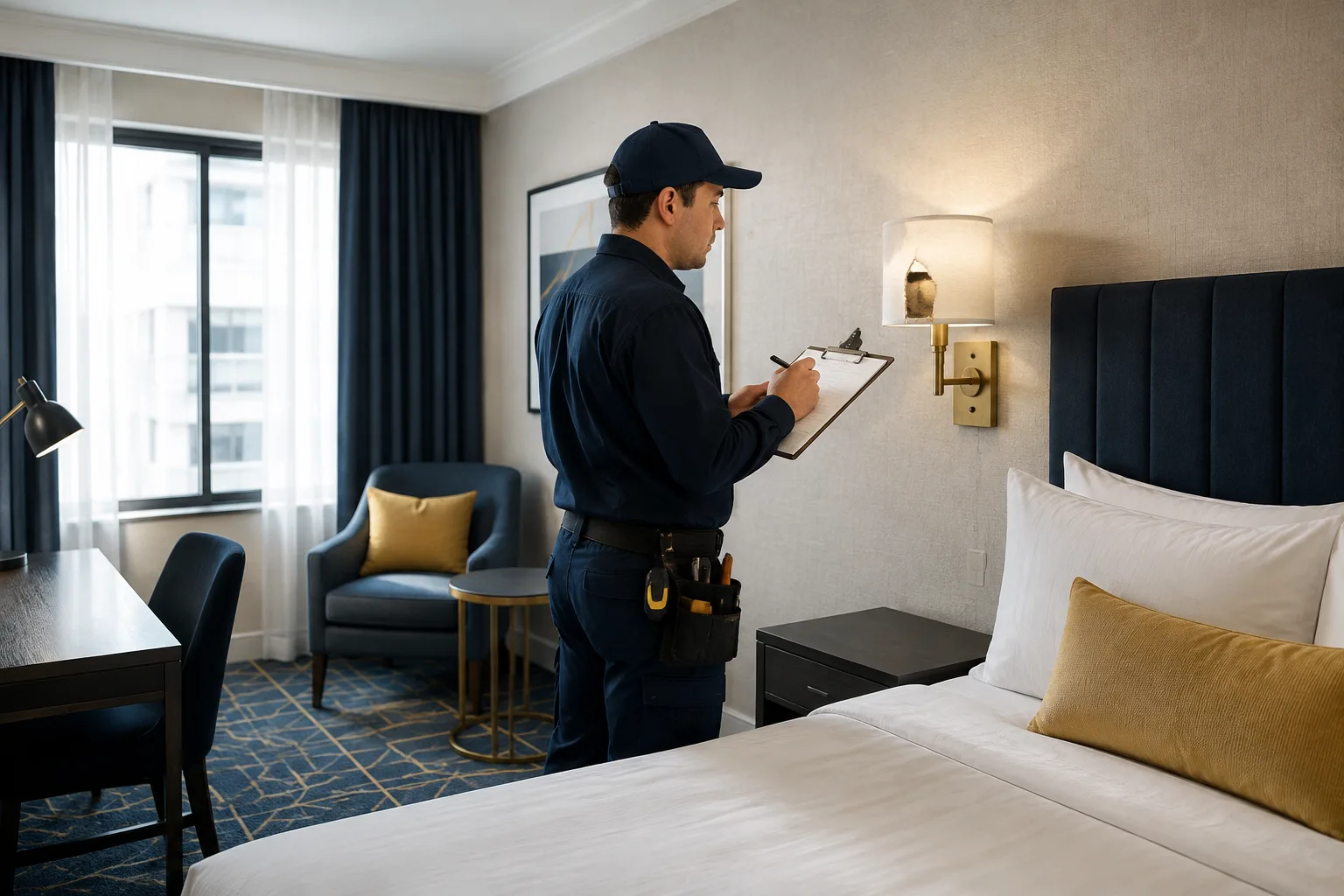
AI-generated editorial illustration; not a customer photograph or product screenshot.
Build a responsibility map for an occupied property
Building maintenance begins with knowing who can authorize access, who owns the equipment, and who is responsible for restoring the affected service. A tenant may report a problem in a room while the relevant equipment sits in a shared plant area. Record both the reported location and the asset relationship so the request does not disappear between the tenant, property manager and service contractor.
Use a responsibility map with one row per service or system. Include the operational owner, the party arranging maintenance, the approved contractor where relevant, the access contact and the escalation route. Lease terms and service contracts may allocate work differently between buildings; have the responsible property professional confirm the actual arrangement. A generic commercial-versus-residential label does not settle responsibility.
Test the map with an ordinary fault and an access exception. If a technician arrives at a locked plant room, who can provide authorized access? If the reported leak originates outside the tenant's area, who coordinates the investigation? The purpose is to make the next action clear without encouraging unqualified occupants to diagnose or repair building systems.
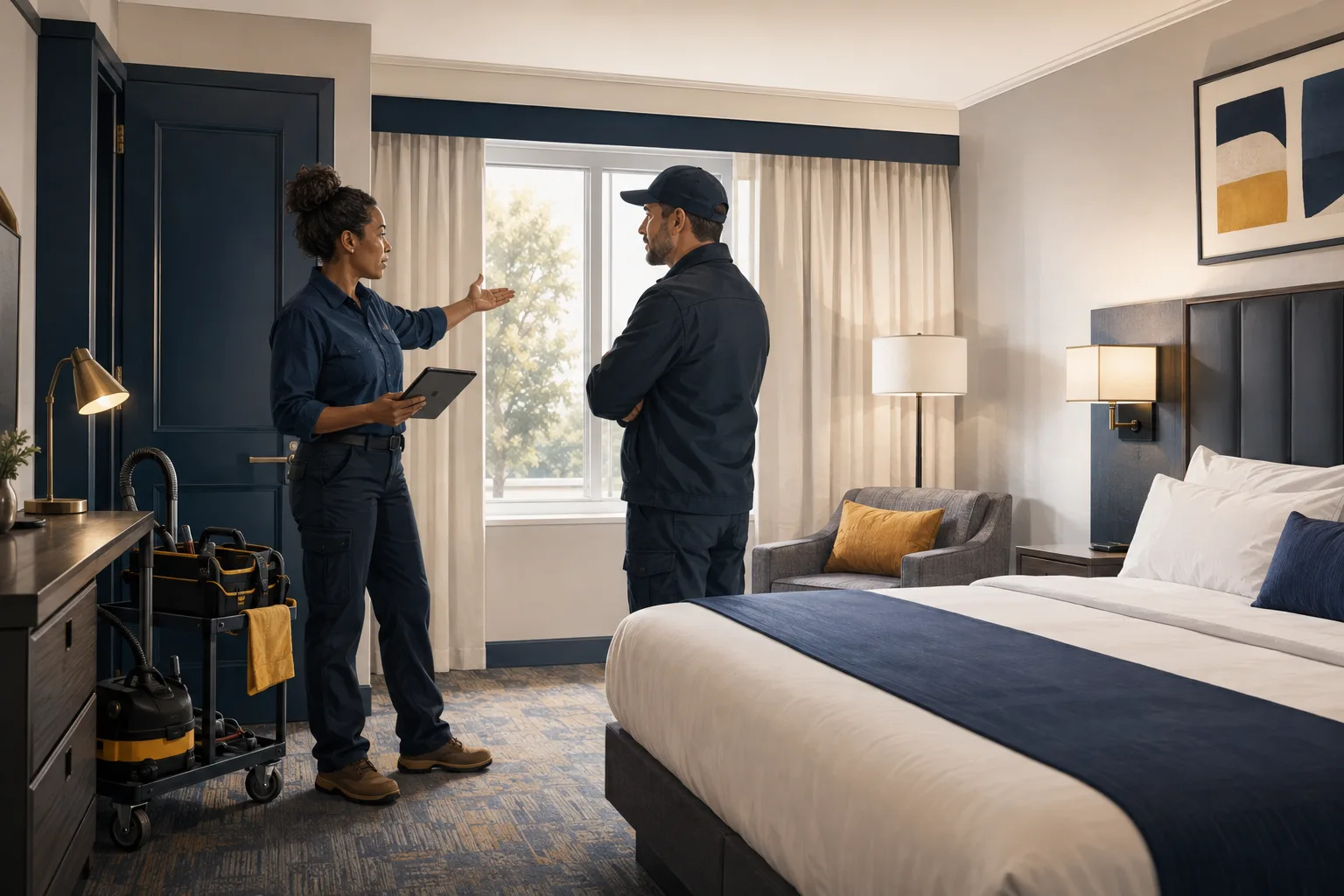
AI-generated editorial illustration; not a customer photograph or product screenshot.
Turn an occupant report into a useful service record
Ask for information an occupant can reasonably provide: the location, observed symptom, when it was noticed and any immediate effect on use of the space. Do not require a requester to choose a technical failure code before a professional has investigated. Give urgent hazards the site's established emergency reporting route rather than relying on an ordinary web form.
During triage, distinguish a duplicate report from a separate event. Several occupants may describe the same service interruption using different room names. Link the reports where appropriate while retaining the affected locations and contacts. Conversely, two similar symptoms in separate systems may need different work orders.
Record access arrangements and communication needs before dispatch. The work description should explain the service problem and the authorized next action, with the applicable procedure or contractor scope. A status change should be understandable to the property team: awaiting access, awaiting a part and awaiting verification imply different follow-up work.

AI-generated editorial illustration; not a customer photograph or product screenshot.
Verify restoration with the people who use the space
Technical completion and occupant communication are separate responsibilities. The contractor may have completed the approved repair while the property manager still needs to verify that the affected space can return to its intended use. Record the required checks and who owns them; do not infer readiness from an invoice alone.
For an illustrative ventilation complaint, retain the reported area, investigation, approved work and verification evidence. If the original symptom remains, record it as unresolved and assign the next investigation. Avoid closing and reopening a series of disconnected tickets that conceal the original history.
Tell affected users what they need to know through the property's approved communication process. Include access changes or temporary restrictions when applicable. Keep private occupant information out of broadly visible maintenance notes unless it is necessary and appropriately controlled.
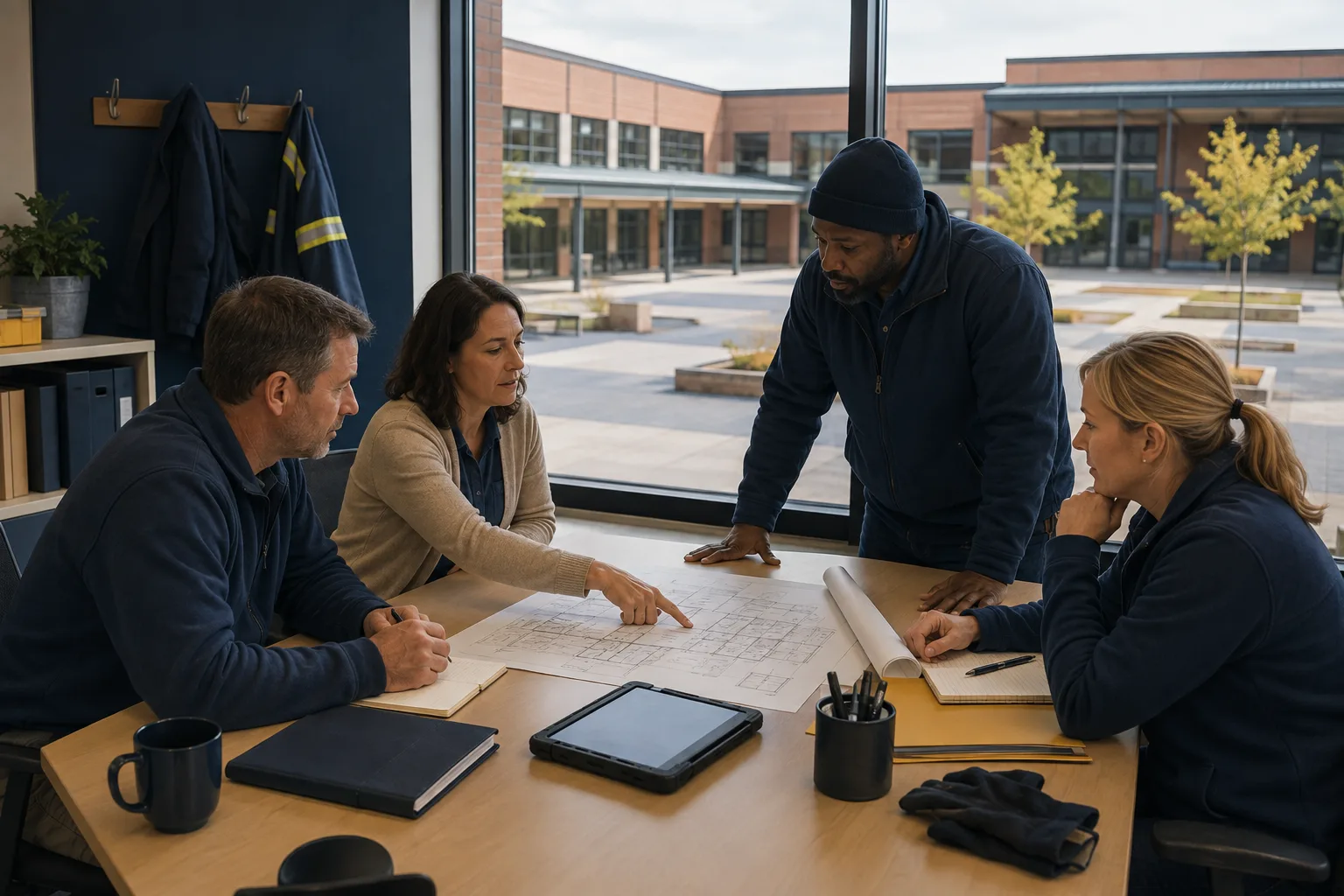
AI-generated editorial illustration; not a customer photograph or product screenshot.
Review recurring building issues by system and location
At a regular property review, group repeated faults by asset, system and reported location. A room-level pattern may point to a shared service issue, while an asset-level pattern may reveal repeated repairs that need a different scope. The record supports a technical investigation; repetition alone does not establish the root cause.
Separate the cost of restoring service from proposed improvement work. A repair request should not silently become a capital project without the relevant authorization. Preserve the evidence that supports a proposed replacement or refurbishment, including condition findings, operational impact and unresolved limitations.
Use the building maintenance guide for the broader maintenance-plan structure. To test the recordkeeping workflow, take one real report through facility fault and readiness records, complete the resulting work and retrieve the history with another authorized user. That test shows whether the system helps the property team coordinate its actual responsibilities.