Facility maintenance services need a defined scope and a person responsible for accepting the result. Hard services, soft services and integrated contracts can organize delivery differently; the facility still needs to know what is included, what remains unresolved and who owns the next decision.
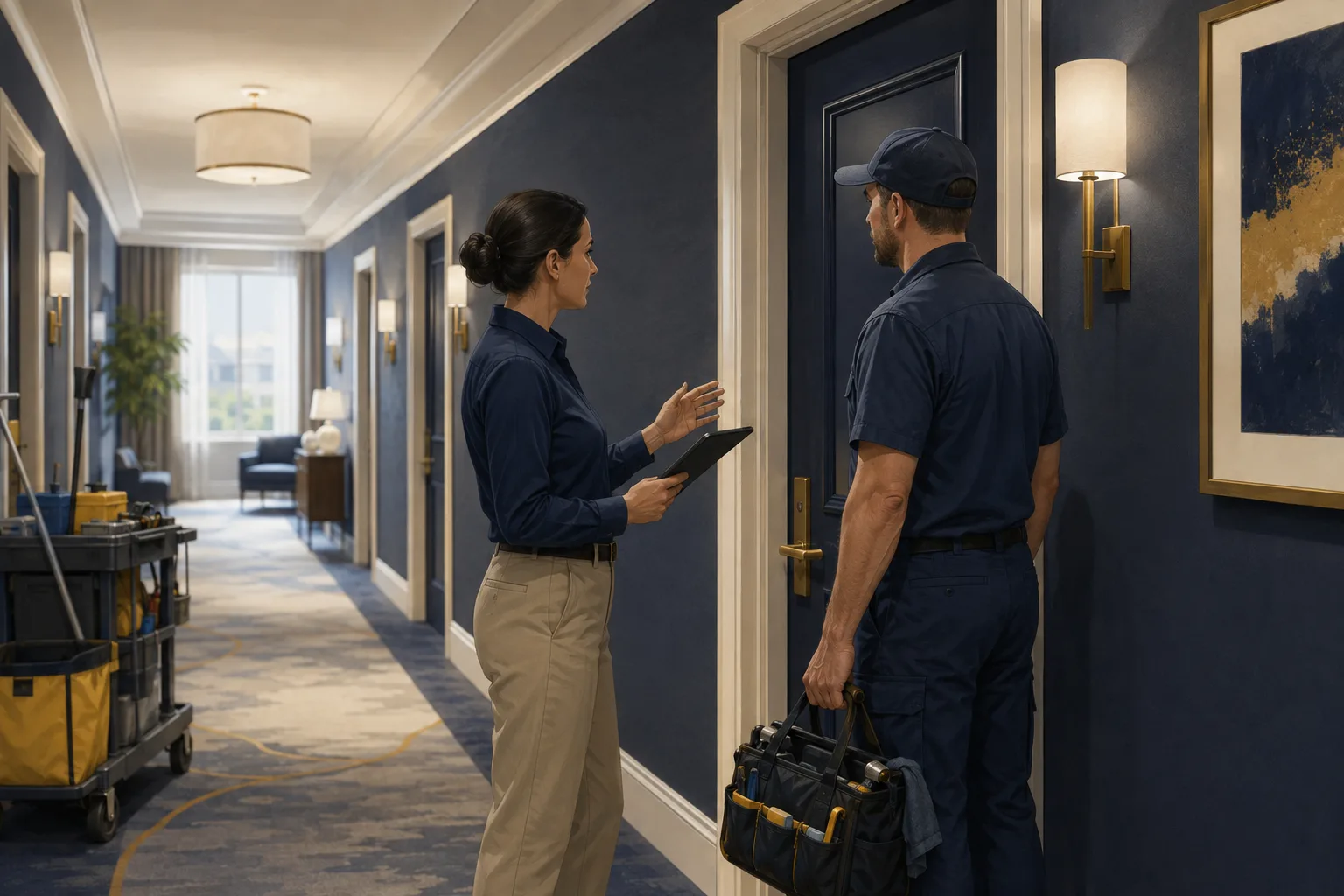
AI-generated editorial illustration; not a customer photograph or product screenshot.
Hard Services vs Soft Services
Facility maintenance encompasses two broad service categories: hard services and soft services. Understanding this distinction is essential for structuring maintenance programs, allocating budgets, managing vendors, and ensuring comprehensive facility operations.
Hard Services: Technical Building Systems
Hard services refer to technical, engineering-focused maintenance activities related to physical building infrastructure and mechanical, electrical, and plumbing (MEP) systems. These services require specialized technical skills, certifications, and often regulatory compliance expertise.
Electrical Systems maintenance ensures reliable, safe power distribution throughout the facility. Key components include main distribution panels and switchgear, circuit breakers and protective devices, transformers and power conditioning equipment, emergency generators and uninterruptible power supplies (UPS), lighting systems including interior, exterior, and emergency lighting, electrical motors and drives, and ground fault protection and surge suppression systems.
Plumbing and Water Systems maintenance addresses both potable water delivery and wastewater removal. Services include domestic water distribution piping and fixtures, water heaters and recirculation systems, backflow prevention and cross-connection control, sanitary and storm drainage systems, sump pumps and sewage ejectors, water treatment systems and filters, and irrigation systems for landscaped areas.
Fire and Life Safety Systems demand meticulous maintenance and documentation due to stringent code requirements. Critical systems include fire alarm and detection systems, fire sprinkler systems, emergency lighting and exit signs, fire extinguishers and fire suppression systems, smoke control and exhaust systems, fire doors and fire-rated assemblies, and emergency communication systems.
Building Automation Systems (BAS) have become increasingly sophisticated, integrating HVAC, lighting, security, and other systems into unified control platforms. Maintenance includes software updates and cybersecurity measures, sensor calibration and accuracy verification, control sequence optimization, user interface programming, data trending and analytics, and integration with other building systems.
Structural Maintenance preserves the building envelope and structural integrity. This encompasses roof systems and waterproofing, exterior walls and cladding, foundations and structural supports, windows and glazing systems, doors and hardware, and parking structures and loading docks.
Soft Services: Non-Technical Support Services
Soft services encompass non-technical facility support activities focused on cleanliness, aesthetics, security, and occupant services. While not requiring engineering expertise, these services significantly impact occupant satisfaction, productivity, and the overall facility experience.
Cleaning and Janitorial Services maintain hygienic, presentable environments through daily cleaning of office spaces and common areas, restroom cleaning and consumable replenishment, floor care including vacuuming, mopping, and periodic deep cleaning, window washing, trash and recycling collection and disposal, carpet cleaning and upholstery maintenance, and high-touch surface disinfection (particularly important post-pandemic).
Landscaping and Grounds Maintenance preserves exterior aesthetics and functionality. Services include lawn mowing and edging, pruning and trimming of trees and shrubs, seasonal plantings and bed maintenance, irrigation system operation and adjustment, leaf and debris removal, snow removal and ice management in applicable climates, and parking lot sweeping and maintenance.
Pest Control prevents and addresses infestations through regular inspections and monitoring, preventive treatments and exclusion measures, responsive treatment when issues arise, and documentation for health and safety compliance.
Security Services may include staffed reception and access control, patrol and monitoring services, CCTV system monitoring, visitor management, and incident response and documentation.
Catering and Vending Services in some facilities provide break room management, vending machine stocking and maintenance, cafeteria operations, and coffee service programs.
Waste Management extends beyond basic trash collection to include recycling program management, composting programs, hazardous waste handling and disposal, and compactor and dumpster maintenance.
Integrated Facility Management
Many organizations adopt integrated facility management (IFM) approaches that combine hard and soft services under unified management. IFM offers several advantages: single point of accountability for all facility services, coordinated scheduling reducing occupant disruption, unified reporting and performance metrics, potential cost savings through economies of scale, and simplified vendor management and contract administration.
IFM can be delivered through various models. Total facility management (TFM) outsources all hard and soft services to a single provider. Bundled services combine related service categories under one contract. Managing agent models employ a third party to coordinate multiple specialized vendors. Self-performed IFM uses in-house teams to deliver integrated services.
The choice between integrated and separate service delivery depends on facility size and complexity, availability of qualified IFM providers in your market, internal staff capabilities and bandwidth, cost-benefit analysis, and desired level of control and flexibility.
Outsourcing Considerations
Most facilities outsource at least some maintenance services, particularly specialized hard services requiring certifications and soft services representing non-core competencies. Key outsourcing decisions should consider technical expertise requirements and availability of qualified internal staff, cost comparison between in-house and contracted services including overhead, equipment, and liability, flexibility needs for scaling services up or down, quality control and performance monitoring capabilities, regulatory compliance and liability transfer considerations, and organizational culture and preference for direct control versus vendor management.

AI-generated editorial illustration; not a customer photograph or product screenshot.
Facility Maintenance Cost Management
Controlling maintenance costs while maintaining high service levels represents a perpetual challenge for facility managers. Effective cost management requires understanding typical expenditures, implementing cost reduction strategies, and measuring return on investment for maintenance programs.
These benchmarks represent total maintenance expenditures including labor, materials, contracted services, and utilities allocated to facilities. They typically exclude capital improvements and major renovations, though definitions vary across organizations.
Cost Reduction Strategies
Facility managers can implement multiple strategies to control and reduce maintenance costs without compromising service quality.
Vendor contract optimization reduces procurement costs through periodic competitive bidding ensuring market-rate pricing, negotiating volume discounts for multiple buildings or services, performance-based contracts aligning vendor incentives with facility goals, and strategic bundling of related services with single providers to gain economies of scale.
Inventory management improvements reduce carrying costs while ensuring parts availability through just-in-time approaches for non-critical items, vendor-managed inventory for high-volume consumables, standardization on common equipment reducing spare parts variety, and kitting of parts for common preventive maintenance tasks.
Staff productivity improvements maximize internal labor through mobile technology reducing administrative time, preventive maintenance route optimization minimizing travel, improved planning and scheduling reducing delays, skills training enabling technicians to handle broader work scope, and appropriate task delegation freeing skilled trades for complex work.
Strategic outsourcing decisions optimize cost and quality through careful analysis of true in-house costs including overhead, core competency focus retaining critical skills internally, competitive bidding maintaining market awareness, and insourcing of frequently needed services when cost-effective.
Data-driven decision making improves resource allocation through failure analysis identifying chronic problems requiring engineering solutions, cost analysis highlighting high-cost equipment requiring replacement, PM optimization adjusting intervals based on actual equipment performance, and performance benchmarking identifying improvement opportunities.
Preventive maintenance optimization fine-tunes program efficiency by eliminating unnecessary tasks lacking value, adjusting frequencies based on equipment condition and history, condition-based maintenance for appropriate equipment, and predictive maintenance for critical, expensive equipment.
ROI Measurement and Justification
Measuring return on investment from maintenance programs demonstrates value and justifies resource requests. Calculate ROI for specific initiatives including preventive maintenance program implementation, CMMS software investment, energy efficiency improvements, predictive maintenance program development, and staff training and development.
ROI calculations compare total costs including initial investment, ongoing operating costs, and implementation costs against quantified benefits such as reduced emergency repairs and downtime, extended equipment life and deferred replacements, energy cost savings, reduced insurance premiums from improved safety, avoided regulatory fines and penalties, and improved occupant satisfaction and retention.
Document costs and benefits comprehensively. Quantify hard savings like reduced costs and soft benefits such as improved satisfaction, reduced risk, and enhanced reputation. Present ROI analyses in business terms facility and organizational leadership understand, connecting maintenance investments to broader business objectives like operational excellence, risk management, sustainability goals, and asset preservation.
Successful facility managers position maintenance not as an unavoidable expense but as a strategic investment delivering measurable returns through improved reliability, controlled costs, extended asset life, and enhanced organizational performance.

AI-generated editorial illustration; not a customer photograph or product screenshot.
Facility Maintenance Best Practices
Implementing best practices elevates facility maintenance from reactive firefighting to strategic asset management. These approaches optimize performance, control costs, and deliver measurable value to organizations.
CMMS and Software Utilization
Leverage technology to transform maintenance management from paper-based chaos to data-driven excellence. Modern CMMS platforms automate preventive maintenance work order generation, track equipment history and maintenance costs, manage parts inventory and procurement, schedule and assign work efficiently, enable mobile access for field technicians, generate performance reports and analytics, and integrate with building automation and enterprise systems.
Select CMMS solutions appropriate to facility size and complexity. Small facilities with basic needs may succeed with simple, affordable cloud-based platforms. Large, complex facilities benefit from enterprise solutions with advanced analytics, mobile functionality, and system integration capabilities.
Successful CMMS implementation requires adequate data migration and setup, comprehensive user training, ongoing data quality management, and regular utilization of reporting and analytics capabilities. Many facilities purchase CMMS but fail to realize benefits due to inadequate implementation or user adoption.
For more detailed guidance on selecting and implementing facility maintenance software, see our comprehensive [Facility Maintenance Software Guide].
Documentation Standards
Maintain meticulous documentation of all maintenance activities. Comprehensive records enable trend analysis identifying recurring problems, inform equipment replacement decisions, demonstrate regulatory compliance, support warranty claims and litigation, transfer knowledge when personnel change, and benchmark costs and performance.
Establish documentation standards specifying required information for work orders, inspection records, equipment files, compliance certifications, and incident reports. Ensure technicians understand documentation expectations and have tools to capture information efficiently—mobile CMMS apps, digital cameras, and voice recording can simplify field documentation.
Implement quality control processes to verify documentation completeness and accuracy. Periodically audit maintenance records to identify gaps and reinforce standards.
Vendor Management
Develop strategic relationships with reliable contractors and service providers. For outsourced services, implement structured vendor management including clear scope of work and performance expectations in contracts, service level agreements defining response times and quality standards, regular performance reviews and scorecarding, safety qualification and verification processes, competitive bidding periodically to ensure market-rate pricing, and relationship management fostering partnership rather than adversarial dynamics.
Pre-qualify vendors before emergencies arise. Maintain relationships with backup vendors for critical services to ensure availability during peak demand or if primary vendors disappoint. Negotiate favorable terms in advance rather than during emergency situations when leverage is minimal.
For self-performed maintenance, invest in technician training and development to maintain and enhance internal capabilities. Balance in-house expertise with strategic outsourcing based on technical complexity, frequency of need, and cost-effectiveness.
Energy Efficiency and Sustainability
Implement building automation system optimization identifying scheduling improvements, setpoint optimization, dead band adjustments, and equipment staging refinements that reduce energy waste. Commission or retrocommission buildings periodically to restore design performance.
Pursue sustainability objectives through maintenance practices including transition to high-efficiency equipment during replacement cycles, LED lighting retrofits, water conservation measures, refrigerant management minimizing emissions, renewable energy system maintenance for solar or other installations, and waste reduction through recycling and proper disposal.
Many sustainability improvements deliver rapid payback through reduced utility costs while advancing corporate environmental commitments.
Safety Protocols
Prioritize safety in all maintenance activities. Implement comprehensive safety programs including lockout/tagout procedures for equipment isolation, confined space entry protocols, fall protection requirements, electrical safety including arc flash protection, chemical safety and hazard communication, personal protective equipment requirements, and incident reporting and investigation procedures.
Provide regular safety training for all maintenance personnel. Conduct safety audits identifying and correcting hazards. Investigate all incidents and near misses to prevent recurrence. Measure and track safety performance through leading indicators like safety observations and training completion and lagging indicators like incident rates and lost-time accidents.
Recognize that maintenance work often involves inherent hazards. Proper safety practices protect personnel while reducing organizational liability and workers' compensation costs.
Communication Strategies
Establish effective communication processes among maintenance teams, facility managers, occupants, and organizational leadership. Implement structured approaches including regular maintenance team meetings for coordination, work planning, and problem-solving, standard operating procedures ensuring consistent approaches, communication protocols defining how and when to escalate issues, occupant notification systems for planned maintenance activities and disruptions, and reporting frameworks keeping leadership informed of performance, issues, and needs.
Use technology to enhance communication. Mobile devices enable real-time updates from the field. CMMS platforms provide visibility into work status and completion. Digital dashboards communicate performance metrics to stakeholders. Service request portals allow occupants to report issues and track resolution.
Effective communication reduces surprises, manages expectations, demonstrates value, and builds support for maintenance programs and resource requests.

AI-generated editorial illustration; not a customer photograph or product screenshot.
Agree a service boundary before choosing a delivery model
A facility combines equipment, spaces and services that have different owners. Start by defining the boundary of each service and the result the facility needs. For example, maintaining a piece of equipment, cleaning the surrounding space and authorizing the room for use can be separate responsibilities even when a single contractor coordinates them.
Write the boundary in operational terms. Identify what is included, what requires a separate request, who can authorize additional work and what evidence the provider must return. Include interfaces with security, occupants and technical specialists. Ambiguity at those interfaces can create delays even when every individual provider completes its own task.
Review the model with people who handle exceptions. Ask who responds when a provider finds damage outside its scope, cannot gain access, or identifies a condition requiring a specialist. An integrated contract can simplify coordination, but the organization still needs a competent owner for acceptance and escalation.

AI-generated editorial illustration; not a customer photograph or product screenshot.
Create an acceptance record for each service category
Different services need different completion evidence. A repair may require findings, parts and verification. A planned inspection may require the approved checklist and a route for defects. A cleaning service may require confirmation of the agreed area and an exception report. Use evidence that supports the decision rather than forcing every service into an identical form.
Define what the reviewer can accept directly and what needs technical approval. The person checking that a contractor uploaded a document may not be the person qualified to accept the underlying work. Keep the responsible roles visible and preserve the source documentation where it belongs.
Test whether the record supports a later question. Can a replacement facility coordinator determine which area was covered, what was excluded and who accepted the result? If the answer depends on a private message or an individual's memory, improve the handoff before adding more reporting fields.
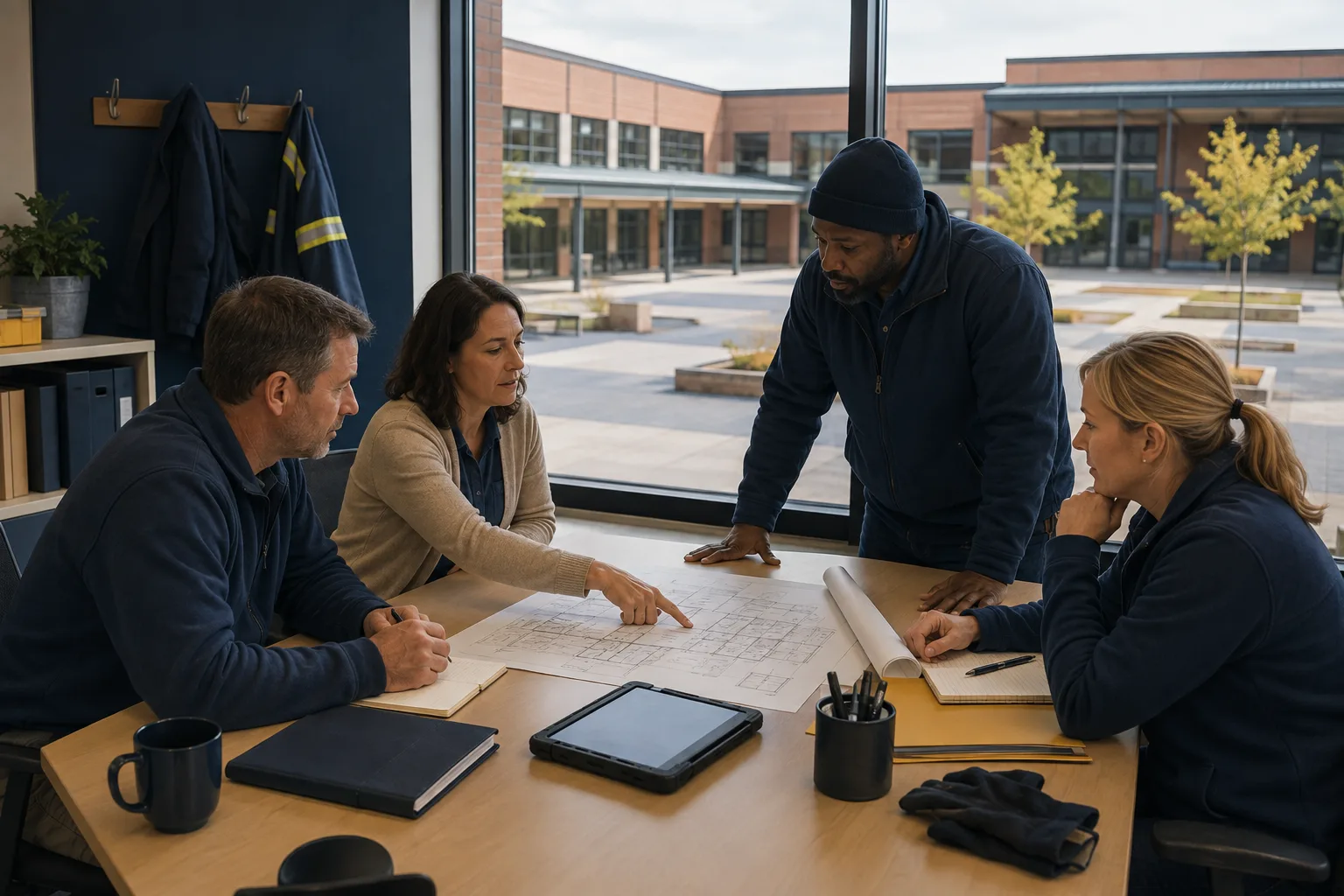
AI-generated editorial illustration; not a customer photograph or product screenshot.
Build the budget from obligations and condition
Start with the known service scope, asset condition, approved maintenance plans and contractual commitments. Separate recurring operating work, corrective backlog and proposed projects. A cost-per-area comparison can provide context only when the included services, building use and accounting boundaries are comparable; it is not a substitute for an actual scope.
For each material budget item, retain the basis of the estimate and its uncertainty. A contracted service has a different evidence basis from an unquoted repair or a potential replacement. Show those differences to the budget owner instead of presenting all figures as equally certain.
Track commitments and completed work separately. An approved order is not the same as an invoice or accepted service. Reconcile the facility record with the organization's purchasing and accounting process so the team can explain what remains to be delivered, reviewed or paid.
Run a service review that produces decisions
Choose a small set of questions for the review: which obligations are coming due, which defects remain unresolved, which services repeatedly fail acceptance and which decisions need authorization? Begin with the underlying records so the meeting can assign specific next actions. A dashboard total without an owner is difficult to act on.
When a service target is missed, examine the reason before assigning blame. Access constraints, incomplete scope, unavailable parts and poor execution require different responses. Keep those categories distinguishable so a provider's apparent performance is not distorted by work it could not control.
Record decisions with an owner and the evidence needed for closure. Revisit unresolved items at the next review. A useful facility service system preserves continuity when contractors, managers or occupants change. It should make the organization less dependent on a single person's memory of every outstanding issue.
Evaluate software against a complete facility handoff
Use one service request, one planned task and one contractor exception during a trial. Check that the asset or location can be identified, work assigned, findings recorded and the resulting readiness decision retrieved. Include the roles that actually perform and accept the work.
PreventiveHQ's facility maintenance workflow supports fault, work and readiness records. Review its published scope before assuming it replaces every property, security, procurement or building-control system. The facility planning guide covers the wider plan that gives those records their operational context.