Introduction
What is predictive maintenance? Predictive maintenance is a proactive maintenance strategy that uses data analytics, machine learning, and IoT sensors to monitor equipment condition in real-time and predict when failures might occur, enabling maintenance to be performed exactly when needed—before breakdowns happen but not unnecessarily early.
In this comprehensive guide, you'll discover how predictive maintenance works, the technologies that power it, step-by-step implementation strategies, real-world ROI calculations, and practical insights for deploying predictive maintenance in your operations. Whether you're in manufacturing, facilities management, transportation, or any industry dependent on critical equipment, this guide will help you understand and implement predictive maintenance successfully.
AI-generated editorial illustration; not a customer photograph or product screenshot.
Predictive Maintenance Technologies
Modern predictive maintenance relies on an integrated technology stack combining sensors, connectivity, data storage, analytics, and user interfaces. Understanding these technologies helps organizations select the right solutions for their specific needs.
IoT Sensors and Condition Monitoring Devices
Sensors form the eyes and ears of predictive maintenance systems, continuously monitoring equipment condition across multiple parameters. The specific sensors required depend on equipment type, failure modes, and operating conditions.
Vibration Sensors
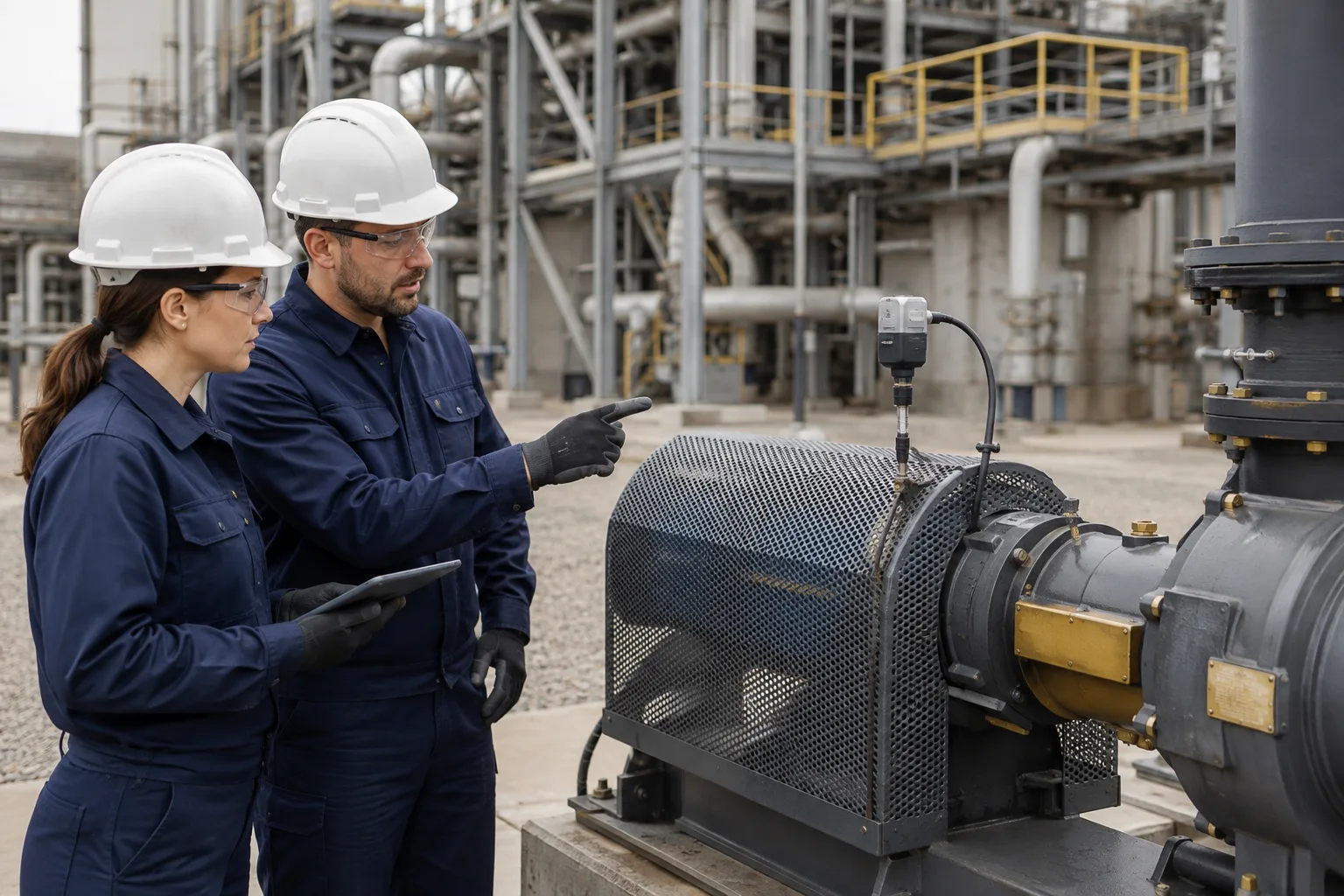
Vibration analysis represents the most widely used predictive maintenance technique, particularly for rotating equipment like motors, pumps, compressors, fans, and turbines. Vibration sensors (accelerometers) detect mechanical problems such as:
Modern wireless vibration sensors can be installed in minutes, measuring acceleration in three axes and transmitting data to cloud platforms for analysis. Advanced installations use permanently mounted sensors that continuously monitor critical assets, while portable sensors can be rotated among less critical equipment on regular routes.
Temperature Sensors
Temperature monitoring detects thermal anomalies that indicate electrical problems, lubrication issues, excessive friction, or process deviations. Predictive maintenance temperature sensing includes:
- Infrared thermography: Thermal imaging cameras create heat maps revealing hot spots in electrical panels, motor windings, bearings, and process equipment
- Point temperature sensors: Thermocouples and RTDs provide continuous monitoring at specific locations
- Thermal sensors: Integrated temperature sensors within equipment provide internal condition monitoring
Temperature increases often precede mechanical or electrical failures by days or weeks, providing valuable early warning. A bearing running 10-15 degrees above normal indicates developing problems that will accelerate wear and lead to failure if not addressed.
Pressure Sensors
Pressure monitoring proves essential for hydraulic systems, pneumatic equipment, compressors, and process systems. Pressure sensors detect:
- Leaks: Gradual pressure drops indicate seal wear or system leaks
- Blockages: Pressure increases suggest filter clogging or line restrictions
- Pump problems: Pressure fluctuations reveal pump wear or cavitation
- Valve issues: Abnormal pressure differentials indicate valve degradation
Modern pressure transducers provide accurate, real-time measurements that feed into predictive algorithms, detecting subtle changes that predict failures before they impact operations.
Acoustic Sensors
Ultrasonic and acoustic sensors detect high-frequency sounds beyond human hearing range, identifying problems like:
- Compressed air leaks: Ultrasonic detection finds leaks that waste energy and reduce system efficiency
- Steam trap failures: Acoustic signatures distinguish properly functioning traps from those that are stuck open or closed
- Bearing defects: Early-stage bearing damage produces ultrasonic emissions before vibration increases become measurable
- Electrical discharge: Partial discharge and arcing in electrical systems produce characteristic acoustic patterns
- Lubrication issues: Dry bearings or gears produce distinct ultrasonic signatures indicating lubrication problems
Acoustic monitoring excels at detecting high-frequency problems that other technologies might miss until later stages of degradation.
Advanced Condition Monitoring Systems
Beyond individual sensors, integrated condition monitoring systems provide comprehensive asset health assessment:
Oil analysis systems monitor lubricant condition, detecting metal particles from wear, contamination levels, additive depletion, and viscosity changes. Online oil sensors provide continuous monitoring while periodic lab analysis offers detailed chemistry evaluation. Oil analysis proves particularly valuable for gearboxes, hydraulic systems, and large engines.
Motor current signature analysis (MCSA) analyzes the electrical signature of motors to detect mechanical and electrical problems without installing additional sensors. Current and voltage analysis reveals rotor bar defects, air gap eccentricity, bearing problems, and load issues.
Partial discharge monitoring detects electrical insulation degradation in transformers, switchgear, motors, and generators before insulation failure causes catastrophic damage.
Corrosion monitoring uses sensors to track corrosion rates in pipelines, vessels, and structures, predicting when thickness will reach minimum acceptable levels.
Machine Learning and Artificial Intelligence
Machine learning algorithms power the intelligence behind predictive maintenance, transforming sensor data into actionable predictions:
Supervised learning trains models on historical data where failure outcomes are known, learning to recognize patterns that precede specific failure modes. Once trained, these models can predict similar failures when they detect those patterns in new data.
Unsupervised learning identifies anomalies by learning normal operating patterns, flagging deviations that might indicate developing problems even for failure modes not previously encountered.
Deep learning neural networks can process complex, multi-dimensional data streams, identifying subtle patterns and correlations that traditional algorithms might miss. Deep learning excels at image analysis for visual inspection automation and complex signal processing.
Remaining useful life (RUL) prediction algorithms estimate how much operating time remains before maintenance is required, enabling optimized scheduling that balances equipment availability with maintenance efficiency.
Predictive Analytics Platforms
Modern predictive maintenance platforms integrate data collection, storage, analysis, and visualization:
Edge computing processes data locally at or near the equipment, reducing latency and bandwidth requirements while enabling real-time alerting even without network connectivity. Edge devices perform initial data processing, sending only relevant information to cloud platforms for deeper analysis.
Integration capabilities connect predictive maintenance platforms with computerized maintenance management systems (CMMS), enterprise resource planning (ERP) systems, and manufacturing execution systems (MES), creating seamless workflows from prediction through work order generation and maintenance execution.
Digital Twins
Digital twin technology creates virtual replicas of physical assets, combining real-time sensor data with physics-based models and historical performance data. Digital twins enable:
- What-if simulations: Testing different operating scenarios without risking actual equipment
- Predictive modeling: Simulating equipment degradation under various conditions
- Optimization: Identifying optimal operating parameters that balance production and asset health
- Training: Creating safe environments for training operators and maintenance technicians
Digital twins represent the convergence of predictive maintenance with broader asset performance management, enabling not just failure prediction but performance optimization.
Technology Comparison Table
Selecting the right combination of technologies depends on your equipment types, failure modes, operating conditions, and criticality levels. Most successful predictive maintenance programs implement multiple complementary technologies to provide comprehensive asset health visibility.
AI-generated editorial illustration; not a customer photograph or product screenshot.
Benefits of Predictive Maintenance
Organizations implementing predictive maintenance experience substantial, measurable benefits across multiple dimensions of operational performance.
Reduced Unplanned Downtime
Unplanned downtime represents the most costly consequence of equipment failures, with losses often measured in thousands or tens of thousands of dollars per hour when factoring in lost production, scrapped work-in-progress, schedule disruptions, and expedited shipping costs to meet customer commitments.
Lower Maintenance Costs
Predictive maintenance reduces maintenance expenditures through multiple mechanisms:
Labor efficiency: Maintenance technicians spend time on necessary, high-value activities rather than unnecessary preventive tasks or reactive firefighting. Precise diagnostics reduce troubleshooting time, enabling faster, more effective repairs.
Extended Equipment Life
Early intervention: Addressing problems in early stages prevents secondary damage. A minor bearing defect costs hundreds to repair; if left undetected until catastrophic failure, the resulting damage to shafts, housings, and connected equipment can cost tens of thousands.
Optimal operating conditions: Continuous monitoring enables optimization of operating parameters—load, speed, temperature—to minimize stress and degradation while maintaining production targets.
Quality repairs: Comprehensive diagnostics ensure repairs address root causes rather than symptoms, preventing recurring failures that accelerate equipment wear.
Improved Safety
Equipment failures pose significant safety risks to personnel and facilities. Predictive maintenance enhances safety by:
Preventing catastrophic failures: Early detection prevents violent failures—exploding components, released pressure, chemical spills, or fires—that endanger personnel.
Reducing emergency repairs: Planned maintenance in controlled conditions is inherently safer than emergency repairs under pressure with inadequate preparation.
Trend monitoring: Gradual deterioration detection enables addressing problems before they create safety hazards.
Better Resource Allocation
Predictive maintenance enables strategic resource deployment:
Priority-based planning: Data-driven prioritization ensures maintenance resources focus on assets with highest failure probability and operational impact rather than rigid schedules or subjective assessments.
Skill matching: Advance knowledge of required repairs enables scheduling appropriately skilled technicians with necessary certifications and training.
Contractor management: Long lead times for predicted maintenance enable competitive bidding and planning with contractors rather than expensive emergency callouts.
Enhanced Productivity and Quality
Beyond preventing failures, predictive maintenance enhances operational performance:
Performance optimization: Continuous monitoring reveals opportunities to optimize operating parameters for better efficiency, quality, and throughput.
Quality improvement: Equipment degradation often impacts product quality before causing failures. Early detection maintains consistent product quality.
Real-world implementations demonstrate compelling returns:
These benefits compound over time as predictive models learn and improve, technicians develop expertise in interpreting predictions, and organizations optimize processes around predictive insights.

AI-generated editorial illustration; not a customer photograph or product screenshot.
Predictive Maintenance Implementation
Successful predictive maintenance implementation requires systematic planning and execution following methodologies.
Assessment and Planning Phase
Begin with comprehensive assessment of current state and future objectives:
Failure mode and effects analysis (FMEA) documents potential failure modes for critical equipment, their consequences, current detection methods, and frequency. This analysis reveals which failures predictive maintenance could prevent and their associated costs, building the business case.
Current state assessment evaluates existing condition monitoring practices, available data infrastructure, maintenance team capabilities, and integration requirements with current CMMS and control systems.
Goal definition establishes specific, measurable objectives: target downtime reduction, cost savings goals, equipment coverage targets, and timeline expectations. Clear goals guide technology selection and enable ROI measurement.
Asset Selection and Prioritization
Not all equipment warrants predictive maintenance investment. Prioritize assets based on:
Criticality assessment identifies equipment whose failure significantly impacts production, safety, or costs. Critical equipment—bottleneck assets, safety systems, high-consequence failures—receives priority.
Failure frequency analysis examines maintenance history to identify assets with frequent or recurring problems that predictive maintenance could prevent.
Downtime cost calculation quantifies hourly costs of equipment unavailability, including lost production, quality impacts, schedule disruptions, and safety risks.
Predictability potential evaluates whether failures develop gradually with detectable precursors versus instantaneous failures that predictive maintenance cannot address.
Most organizations begin with 10-20 critical assets for pilot programs, expanding coverage systematically based on value and developed expertise.
Technology Selection
Select technologies matching your equipment types, failure modes, and organizational capabilities:
Sensor selection based on equipment characteristics and failure modes—vibration for rotating equipment, temperature for electrical and bearing monitoring, pressure for hydraulics and pneumatics, acoustic for leaks and lubrication.
Platform evaluation comparing cloud platforms based on analytics capabilities, integration options, user interface, scalability, vendor support, and total cost of ownership. Consider whether to adopt comprehensive platforms or integrate best-of-breed point solutions.
Connectivity planning determining network requirements—Wi-Fi, cellular, LoRaWAN, hardwired Ethernet—based on facility infrastructure, equipment locations, and data volume.
Integration requirements with existing CMMS, ERP, and control systems to ensure seamless workflows from prediction through work order generation and execution.
Sensor Installation and Commissioning
Physical deployment requires attention to detail:
Installation planning identifies optimal sensor locations based on vibration transmission paths, temperature measurement points, and accessibility for wireless communication.
Professional installation ensures proper mounting techniques, correct sensor orientation, secure wiring, and verification of signal quality. Poor installation compromises data quality and prediction accuracy.
Calibration and verification confirms sensors measure accurately and data flows correctly through the entire chain from sensor through platform to user interface.
Data Infrastructure Setup
Robust data infrastructure ensures reliable operation:
Network implementation establishes reliable connectivity from sensors through gateways to analytics platforms, with adequate bandwidth and redundancy for critical systems.
Edge computing deployment installs edge devices for local processing, real-time alerting, and data buffering during network interruptions.
Cloud platform configuration sets up data storage, establishes retention policies, configures security and access controls, and establishes integration connections.
Data governance establishes policies for data ownership, access, retention, security, and privacy compliance.
Analytics Configuration and Model Training
Configure analytics to match your specific environment:
Algorithm selection chooses appropriate techniques for each asset type and failure mode—frequency analysis for rotating equipment, statistical process control for process parameters, machine learning for complex multi-parameter analysis.
Model training feeds historical failure data and current operational data into machine learning algorithms, enabling them to learn relationships between sensor patterns and failure modes.
Threshold optimization establishes alert thresholds that balance early detection with acceptable false positive rates, adjusting based on experience.
Validation testing verifies that models correctly identify known historical failures and generate appropriate alerts for developing problems.
Team Training and Change Management
Technology succeeds only with organizational adoption:
Maintenance team training develops skills in interpreting predictive insights, understanding sensor data, and integrating predictions into maintenance planning and execution.
Operator training educates production personnel on alert response procedures and how predictive maintenance supports their operations.
Management engagement ensures leadership understands predictive maintenance value, supports required process changes, and makes decisions guided by data rather than tradition.
Change management addresses cultural resistance to data-driven decision making, establishes new workflows, and develops metrics demonstrating value.
Pilot Program Execution
Validate approach with focused pilot programs:
Limited scope deployment implements predictive maintenance on carefully selected pilot assets, proving value before full-scale rollout.
Intensive monitoring tracks pilot performance, captures lessons learned, identifies process improvements, and documents successes and challenges.
ROI measurement quantifies pilot program benefits—prevented failures, avoided downtime, cost savings—building the case for expansion.
Process refinement adjusts alerting thresholds, improves workflows, enhances training, and optimizes technology configurations based on pilot experience.
Full Deployment and Continuous Improvement
Expand systematically based on pilot success:
Phased rollout extends predictive maintenance coverage to additional assets in priority order, applying lessons learned from pilot programs.
Performance monitoring tracks key metrics—prediction accuracy, false positive rates, mean time between failures, downtime trends, maintenance costs—measuring progress toward goals.
Continuous improvement refines models based on experience, expands failure mode libraries, optimizes thresholds, and enhances processes as organizational maturity increases.
Capability expansion extends predictive maintenance to additional asset types, implements advanced techniques like remaining useful life prediction, and integrates deeper into planning and execution systems.
Implementation Timeline
Typical implementation timeline for medium-sized facility:
- Months 1-2: Assessment, planning, technology selection, business case development
- Months 3-4: Pilot asset selection, sensor procurement, platform setup, initial installation
- Months 5-6: Baseline data collection, model training, team training, alert configuration
- Months 7-9: Pilot operation, validation, refinement, ROI measurement
- Months 10-18: Phased expansion to additional assets, process optimization, capability enhancement

AI-generated editorial illustration; not a customer photograph or product screenshot.
Predictive Maintenance ROI
Understanding predictive maintenance return on investment helps organizations make informed implementation decisions and measure program success.
Cost Analysis Framework
Comprehensive ROI calculation accounts for all costs and benefits:
Ongoing costs include:
- Software subscriptions: Annual platform fees
- Connectivity: Cellular data plans, network infrastructure
- Maintenance: Sensor calibration, replacement, system updates
- Personnel: Reliability engineer or predictive maintenance specialist roles
Benefit categories include:
- Avoided downtime costs: Production losses prevented through early failure detection
- Maintenance cost savings: Reduced emergency repairs, optimized preventive maintenance, extended component life
- Energy savings: Improved equipment efficiency
- Quality improvements: Reduced defects from equipment degradation
- Safety benefits: Prevented injuries and accidents
- Inventory optimization: Reduced spare parts carrying costs
ROI Calculation Methodology
Calculate ROI using this framework:
Annual downtime savings: (Historical unplanned downtime hours) × (Expected reduction percentage) × (Hourly production value + downtime costs)
Annual maintenance savings: (Current annual maintenance costs) × (Expected cost reduction percentage)
Total annual benefits: Sum of downtime savings, maintenance savings, quality improvements, and energy savings
Net annual benefit: Total annual benefits minus ongoing annual costs
Period ROI: (Benefits in the period minus all costs in the same period) divided by those costs, multiplied by 100
Simple payback in years: Initial investment divided by positive annual net cash benefit; this assumes steady benefits and excludes discounting
Cost-Benefit Comparison: Predictive vs Preventive Maintenance
Comparative analysis demonstrates predictive maintenance advantages:
This comparison illustrates how predictive maintenance simultaneously reduces both planned maintenance costs (through optimization) and unplanned downtime costs (through early detection).
Maximizing ROI
Optimize predictive maintenance ROI through:
Focus on critical assets: Prioritize equipment with highest downtime costs and failure frequency Comprehensive failure cost accounting: Include all consequence costs—lost production, quality impacts, expedited shipping, safety incidents Continuous improvement: Refine models and thresholds based on experience to improve prediction accuracy Integration depth: Connect predictive insights seamlessly into maintenance planning and execution workflows Capability expansion: Extend monitoring coverage and advance from fault detection to remaining useful life prediction
Challenges and Considerations
While predictive maintenance delivers substantial benefits, organizations must navigate several challenges for successful implementation.
Implementation Costs and Investment Justification
Upfront investment represents a significant barrier, particularly for small and medium-sized organizations. Sensor hardware, analytics platforms, installation labor, and training require capital investment before benefits materialize. Organizations can address this through:
Phased implementation: Start with pilot programs on highest-impact assets, using early successes to fund expansion Cloud platforms: Leverage subscription models that spread costs over time rather than large upfront capital investments Government incentives: Explore tax credits, grants, and incentive programs for Industry 4.0 adoption Leasing options: Some vendors offer sensor and platform leasing arrangements that align costs with benefits
Data Quality Requirements
Predictive maintenance algorithms depend on high-quality data. Poor data quality—sensor calibration drift, network interruptions, environmental interference—compromises prediction accuracy. Address through:
Robust sensor installation: Professional installation ensures reliable data collection Regular calibration: Periodic sensor verification maintains measurement accuracy Data validation: Automated quality checks identify sensor problems and data anomalies Redundancy: Multiple sensors monitoring critical assets provide validation and continuity
Skill Requirements and Training
Predictive maintenance requires new skills many maintenance teams lack—data analysis, statistical methods, frequency analysis, algorithm interpretation. Bridge this gap through:
Comprehensive training programs: Invest in developing team capabilities in condition monitoring and data analysis Hiring specialists: Add reliability engineers with predictive maintenance expertise to teams Vendor support: Leverage platform vendor expertise during implementation and early operation User-friendly interfaces: Select platforms with intuitive interfaces that minimize required technical expertise
Integration Complexity
Connecting predictive maintenance platforms with existing CMMS, ERP, and control systems presents technical challenges. Poor integration results in disconnected workflows that limit value realization. Address through:
API-first platforms: Select solutions offering robust integration capabilities Implementation support: Work with experienced integrators for complex enterprise system connections Standardized workflows: Develop clear processes for how predictions flow into work orders and maintenance execution Change management: Ensure organizational processes adapt to integrated workflows
Change Management and Organizational Adoption
Cultural resistance to data-driven decision making represents a significant challenge. Experienced technicians may trust intuition over algorithms; planners may resist changing established preventive maintenance schedules. Overcome through:
Demonstrating value: Use pilot program successes to build credibility Including teams early: Involve maintenance personnel in technology selection and implementation Hybrid approaches: Initially supplement rather than replace existing practices, building confidence gradually Clear communication: Explain how predictive maintenance supports rather than replaces technician expertise
False Positives and Alert Fatigue
Overly sensitive systems generating excessive alerts create "alert fatigue" where teams ignore notifications, undermining program effectiveness. Balance through:
Threshold optimization: Adjust alert sensitivities based on experience to minimize false positives Alert prioritization: Implement severity levels that distinguish critical from informational alerts Feedback loops: Enable technicians to provide feedback on alert accuracy, informing continuous improvement Periodic review: Regularly assess alert patterns and adjust configurations
Technology Evolution and Future-Proofing
Rapid technology evolution creates concerns about investment obsolescence. Select solutions that adapt through:
Open platforms: Choose solutions based on open standards and robust APIs rather than proprietary ecosystems Cloud-based systems: Leverage platforms that receive continuous updates and capability enhancements Modular architecture: Implement systems where components can be upgraded independently Vendor roadmaps: Evaluate vendor commitment to ongoing development and support
Despite these challenges, organizations successfully implementing predictive maintenance report that benefits far exceed obstacles, with systematic planning and execution overcoming most barriers.

AI-generated editorial illustration; not a customer photograph or product screenshot.
Frequently Asked Questions About Predictive Maintenance
What is predictive maintenance?
Predictive maintenance is a proactive maintenance strategy that uses condition-monitoring technologies, data analytics, and machine learning to monitor equipment in real-time and predict when failures might occur. Unlike reactive maintenance (run-to-failure) or preventive maintenance (time-based schedules), predictive maintenance bases maintenance decisions on actual equipment condition data. Sensors continuously measure parameters like vibration, temperature, pressure, and acoustic emissions, with analytics platforms detecting patterns that indicate developing problems. This enables maintenance exactly when needed—before failures occur but not unnecessarily early—optimizing equipment availability while minimizing maintenance costs.
What technologies are used in predictive maintenance?
Predictive maintenance integrates multiple technologies: Sensors collect equipment condition data—vibration sensors for rotating equipment, temperature sensors for electrical and mechanical systems, pressure sensors for hydraulic and pneumatic systems, and acoustic sensors for leak detection and lubrication monitoring. IoT connectivity transmits sensor data through wireless networks, cellular connections, or industrial Ethernet to analytics platforms. Cloud computing provides scalable infrastructure for data storage and powerful analytics processing. Machine learning and AI algorithms analyze data patterns to predict failures, estimate remaining useful life, and generate maintenance recommendations. Edge computing enables local data processing and real-time alerting. Digital twins create virtual equipment replicas combining sensor data with physics-based models. Integration platforms connect predictive systems with CMMS, ERP, and control systems. For comprehensive information about monitoring technologies, visit our IoT Sensors guide.
What industries benefit most from predictive maintenance?
Predictive maintenance delivers value across virtually all industries with critical equipment, but particularly high-impact sectors include: Manufacturing where equipment failures halt production lines causing costly downtime. Energy and utilities with expensive critical assets (turbines, generators, transformers) where failures cause major outages. Transportation including aviation, rail, and fleet operations where safety and availability are paramount. Oil and gas with remote, critical equipment where failures cause production losses and safety hazards. Healthcare where medical equipment availability directly impacts patient care. Data centers where equipment failures cause service interruptions. Food and beverage where downtime causes product waste and missed delivery commitments. Mining with expensive heavy equipment operating in harsh conditions. The common thread is operations where equipment availability significantly impacts production, safety, costs, or customer service, making failure prevention economically compelling.

AI-generated editorial illustration; not a customer photograph or product screenshot.
Conclusion
Predictive maintenance represents a fundamental transformation in how organizations manage their most critical assets, moving from reactive firefighting and inefficient scheduled maintenance to intelligent, data-driven optimization. By continuously monitoring equipment condition through IoT sensors, analyzing data with machine learning algorithms, and predicting failures before they occur, predictive maintenance enables maintenance exactly when needed—maximizing availability while minimizing costs.
Successful implementation requires systematic planning: comprehensive assessment of current state and objectives, strategic asset prioritization focusing on critical equipment with highest downtime costs, careful technology selection matching equipment types and failure modes, professional installation ensuring data quality, thorough team training, and phased deployment beginning with pilot programs that prove value before full-scale rollout.
While challenges exist—implementation costs, data quality requirements, skill gaps, integration complexity, and change management—organizations successfully navigating these obstacles consistently report that benefits far exceed barriers. The key is viewing predictive maintenance not as a technology project but as a strategic operational improvement program that fundamentally enhances how organizations manage their assets.
As Industry 4.0 continues evolving, predictive maintenance will expand beyond failure prevention to comprehensive asset performance optimization, integrating with digital twins, production systems, and quality management to enable truly autonomous, intelligent operations. Organizations beginning predictive maintenance journeys today position themselves for continued competitive advantage as these capabilities mature.
The question for organizations dependent on critical equipment is no longer whether to implement predictive maintenance, but how quickly they can deploy it effectively to capture available benefits. Every unplanned failure, every unnecessary preventive maintenance intervention, and every piece of equipment operating below optimal condition represents opportunity cost that predictive maintenance can address.
Start your predictive maintenance journey by identifying your most critical assets, quantifying the costs of their failures and current maintenance approaches, and exploring technologies and platforms matched to your specific needs. Whether you manage manufacturing equipment, facility systems, transportation fleets, or any operation dependent on reliable equipment performance, predictive maintenance offers a path to enhanced operational excellence.
Related Resources:
- Preventive vs Predictive Maintenance Comparison
- IoT Sensors for Equipment Monitoring
- Comprehensive Maintenance Strategy Guide
- Condition Monitoring Technologies
Last Updated: October